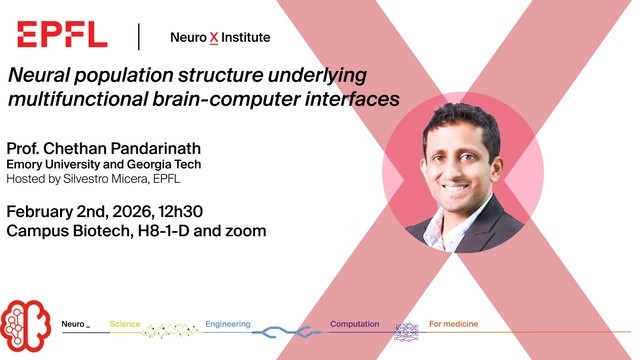
| Date: 02.02.2026
Time: 12:30 – 13:30
Location: H8-01-D
Organizers: EPFL – Neuro-X Institute
Speaker: Prof Chethan Pandarinath
Abstract:
Modern brain-computer interfaces (BCIs) must support diverse, complex behaviors. This talk addresses the challenge of creating multifunctional neuroprosthetics from two perspectives. First, we present a BCI with clinical trial participants that enables intuitive switching between distinct outputs, like speech and cursor control, by seamlessly decoding user intent. Second, using high-channel-count recordings in non-human primates (Neuralink N1), we investigate the neural basis for switching control modes. We reveal that motor cortex employs an abstract, effector-independent geometry for movement planning, distinct from an effector-specific execution layer. This compositional structure provides a powerful neuroscientific blueprint for designing the next generation of scalable and versatile BCIs.
Bio:
Chethan Pandarinath is a neuroengineer and neuroscientist. He strives to better understand how brains perform computations and to design brain-computer interfaces (BCIs) that allow people with paralysis to move and communicate again. Dr. Pandarinath is a tenured Associate Professor in Biomedical Engineering and Neurosurgery at Emory University and Georgia Tech, where he directs the Systems Neural Engineering Lab. He and his group have developed several deep learning methods to uncover neural population dynamics such as LFADS/AutoLFADS, NDT, RADICaL, and NoMAD, and have also led several open science initiatives around latent variable modeling and BCIs such as the Neural Latents Benchmark, the FALCON BCI benchmark, and the Computation through Dynamics Toolkit. Since 2022 he has co-directed the Emory site of the BrainGate clinical trial, with a focus on multifunctional brain-computer interfaces to restore speech and movement control.
Dr. Pandarinath received undergraduate degrees in Computer Engineering, Physics, and Science Policy from NC State, followed by a PhD in EE at Cornell in the area of retinal prosthetic devices. His postdoc at Stanford with Jaimie Henderson, Krishna Shenoy, and David Sussillo focused on improving the performance of clinical BCIs, and developing deep learning methods to model neural population dynamics. He is a 2019 Sloan Fellow, 2021 NIH Director’s New Innovator Awardee, and gave a 2024 Gilbreth Lectureship at the National Academy of Engineering. He has also served as a research scientist and consultant in neuromotor interfaces at Meta Reality Labs. |