
Events
NEURO-CONNECT
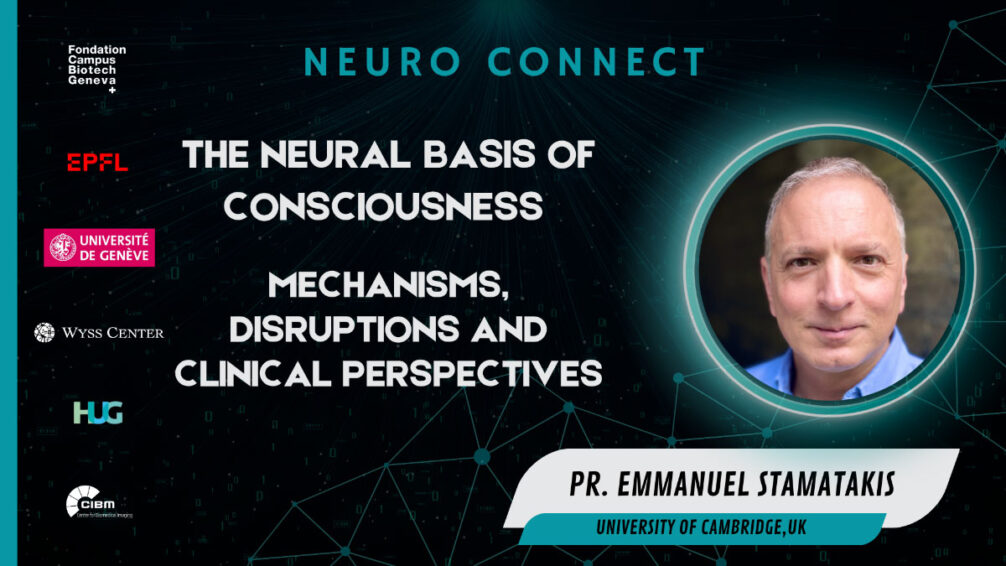
Tuesday Seminar, November 11th, 12:15 – 13:15 pm
Dear all,
You are cordially invited to the next NEURO-Connect seminar, which will take place on November 11th at 12:15 in room H8-01-D at Campus Biotech.
The next session will be hosted by UNIGE. The speaker will be Dr. Emmanuel A.Stamatakis (University of Cambridge), with the talk “The Neural Basis of Consciousness : Mechanisms, Disruptions, and Clinical Perspectives”. Please see abstract and other details below.
Private meetings with Dr. A.Stamatakis can be organized, and early career researchers (ECR, e.g., doctoral and postdoctoral) are encouraged to join the invited speaker for a networking lunch offered by the FCBG (10 spots, first-come, first-served). To indicate your wish to meet one-to-one with Dr. A.Stamatakis, please write to Patrik.Vuilleumier@unige.ch, and to register for the ECR lunch after the talk, please fill-in the following survey Lunch registration. The deadline in both cases is, Monday November 10th. This delay is needed to be able to properly organize the schedule and to order the correct number of meals in time. We thank you for your cooperation.
Doctoral students can receive credits for their attendance, please don’t forget to have your attendance sheet signed.
For any questions on this event, you can contact the session organizer at Patrik.Vuilleumier@unige.ch.
Looking forward to seeing you at NEURO-Connect.
The organizing team
*************************
NEURO-CONNECT seminars
Tuesday, November 11th
12:15 – 13:15
Campus Biotech, H8-1-D
Dr. Emmanuel A.STAMATAKIS (University of Cambridge)
« The Neural Basis of Consciousness: Mechanisms, Disruptions, and Clinical Perspectives »
A central challenge in neuroscience is elucidating how complex cognitive functions—and consciousness itself—emerge from the dynamic interactions of large-scale brain networks. My research addresses this question by integrating advanced neuroimaging modalities, including structural/functional MRI and molecular imaging, with computational frameworks grounded in network science and information theory. By examining brain activity across diverse states—healthy wakefulness, pharmacologically induced unconsciousness, and disorders of consciousness—I aim to identify the neural mechanisms that differentiate conscious from unconscious states.
Empirical findings so far indicate that loss of consciousness, whether due to anaesthesia or severe brain injury, is associated with a pronounced reduction in both information integration and network diversity. These observations suggest that consciousness critically depends on the brain’s capacity to flexibly integrate and process information across distributed regions. In my talk, I will discuss how specific patterns of network interactions support conscious processing and how disruptions to these interactions—particularly within systems such as the Ascending Reticular Activating System—can lead to profound alterations or complete loss of consciousness. These insights offer meaningful contributions to theoretical models of consciousness, while also bearing important implications for clinical practice and the development of innovative therapeutic strategies for individuals with disorders of consciousness.
Zoom:https://eu01web.zoom.us/j/68616269850?pwd=tT5Rm7YarJgaV4ZWQYNa86MEmga0MT.1
Meeting ID: 686 1626 9850
Passcode: 097437