News
Brain-computer interfaces: ABILITY Neurotech moves closer to clinical reality
© ABILITY Neurotech
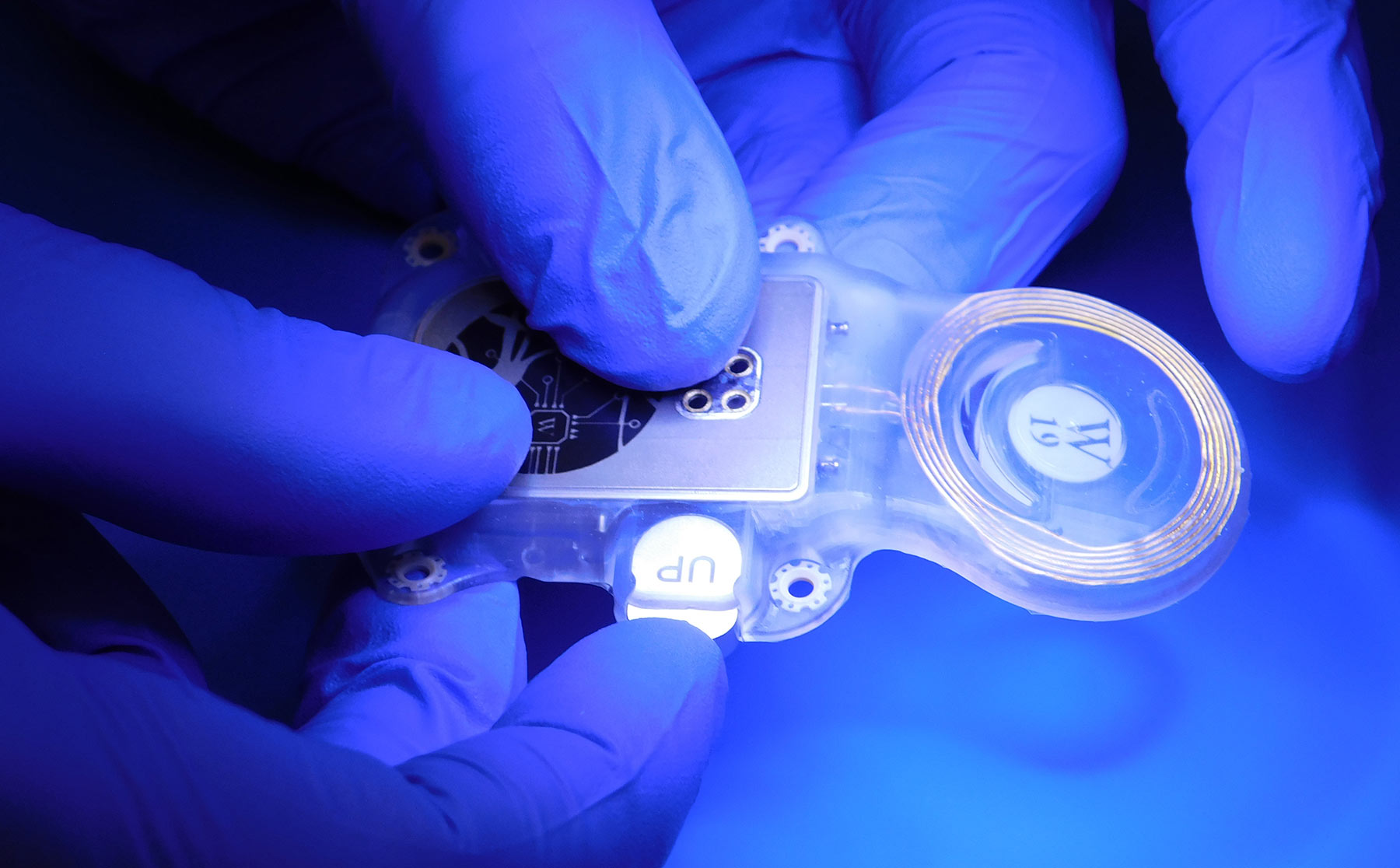
At the intersection of neuroscience, engineering and medicine, ABILITY Neurotech is developing a new generation of implantable brain–computer interfaces. Beyond technological performance, its approach is focused on real-world use — designing solutions that can be meaningfully integrated into patients’ daily lives, in line with the in line with the translational focus of the Campus Biotech.
Brain–computer interfaces designed for real-world use
Translating intention into action is part of everyday life for most of us. For people living with severe neurological conditions — such as amyotrophic lateral sclerosis or certain brainstem strokes — this ability can be lost.
This is precisely what brain–computer interfaces (BCIs) aim to restore. By recording neural activity and decoding the signals associated with intention — forming a word, producing a sentence — these technologies make it possible to turn thought into digital communication.
At ABILITY Neurotech, this ambition takes the form of a fully implantable system that brings together hardware, high-bandwidth data transmission and decoding software within a single clinical platform.
Technological innovation for clinical use
One of the key differentiators of ABILITY’s approach lies in its architecture: an implantable optical system, with no implanted battery, capable of capturing neural data at very high resolution. This technology enables the recording of a full spectrum of neural signals, with a reported data rate of 50 Mb/s, paving the way for faster, more fluid communication than existing assistive technologies.
But beyond performance, development is driven by the ability to integrate these systems into everyday use.
“We maintain a dedicated patient advisory board to ensure that what we design is truly fit for patients, not just something we can build because it’s technically possible. With patients involved from the start, we aim to develop more holistic solutions that go beyond what looks good on paper and can meaningfully improve how they live their lives”, Rotem Kopel, Co-founder and CEO.
From research to application: key clinical milestones in 2026
The year 2026 marks an important step in the development of the technology. Following preclinical work, ABILITY is planning an imminent intraoperative study, along with the launch of its first chronic human trial in the third quarter of 2026. These studies will be conducted in collaboration with leading European clinical centres, including UMC Utrecht and Medizinische Universität Graz.
In parallel, ABILITY took part in the Innovation Summit 2026, organised by MedTech Strategist and held in Dublin from 28 to 30 April.
Its presence on this European medtech stage reflects both the progress of its development and its positioning within a rapidly evolving international ecosystem.
Data at the core of the next generation of BCIs
Beyond the device itself, ABILITY places strong emphasis on neural data as a key driver of performance. Capturing, transmitting and interpreting this data with precision is essential to improving decoding quality and, ultimately, enabling more natural communication.
This full-stack approach — combining hardware, data and software — reflects a broader shift in the field: brain–computer interfaces are no longer just experimental devices, but increasingly complex systems designed for sustained clinical use.
A positioning aligned with the priorities of the Campus Biotech
Supported by the Wyss Center, and like many of the organisations active on the campus, ABILITY Neurotech reflects a broader trend: bringing cutting-edge technologies closer to real patient needs, and integrating considerations of usability, safety and acceptance from the outset.
This shift is key to ensuring that neuroscience evolves not only as an exploratory field, but as one with real transformative impact.